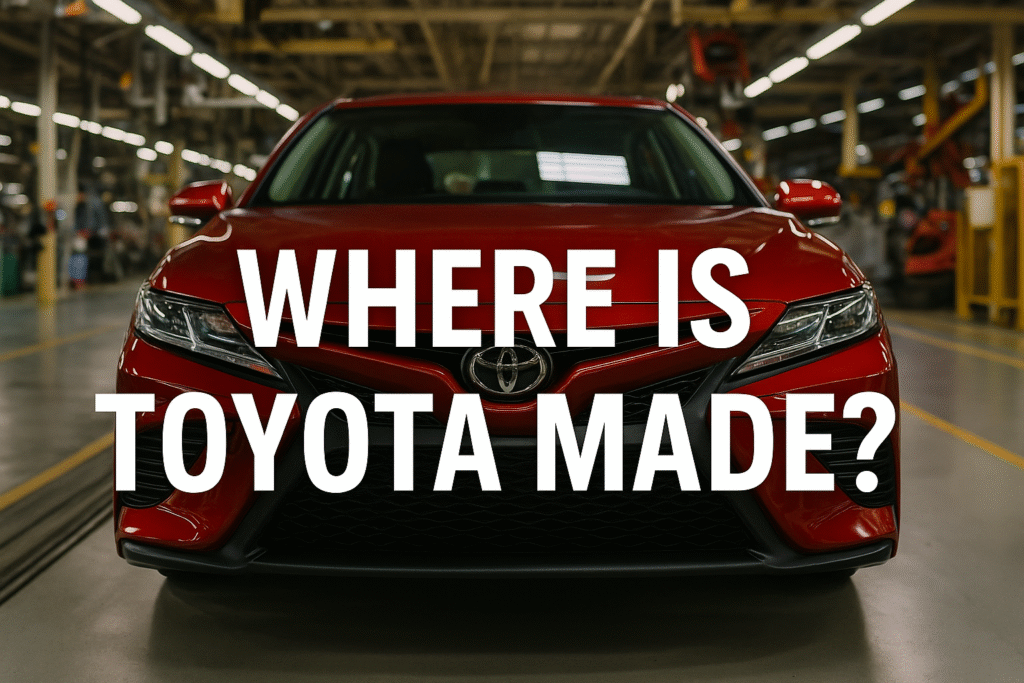

Have you ever wondered where is Toyota made? This guide shares everything you need to know about Toyota’s global manufacturing locations. You’ll learn where Toyota builds cars and engines around the world, why they choose those places, and how Toyota’s factories support local communities.
We’ll cover:
- Toyota’s origins and Japan plants
- North America, Europe, Asia, Africa, and South America facilities
- Why Toyota makes cars close to customers
- Highlights of key factories
- Community and economic impact
Toyota’s Roots: Made in Japan
Toyota Motor Corporation started in Japan in 1937. That country remains Toyota’s core manufacturing base. There are many plants in Japan including:
- Honsha Plant (parts, hybrid systems), opened 1938
- Motomachi Plant (cars like Crown, Prius, GR Corolla), opened 1959
- Tsutsumi Plant (Prius, Camry, Corolla), opened 1970
- Tahara Plant (Land Cruiser, Lexus luxury cars, engines), opened 1979
- And many others including Hybrids and transmission plants across East Japan.([turn0search4])
These Japanese factories create many of Toyota’s hybrid systems and carry its tradition of quality and innovation.
North America: Made in USA, Canada & Mexico
Toyota has a huge presence in North America, earning the question “where is Toyota made?” clear answers.
United States Plants:
- Kentucky (Georgetown, KY) – TMMK: Toyota’s largest plant outside Japan. Builds Camry, RAV4, Lexus ES, and engines.([turn0search32])
- Indiana (Princeton, IN) – TMMI: Produces full-size SUVs like Highlander, Sienna, and Lexus TX.([turn0search7])
- Texas (San Antonio, TX) – TMMTX: Builds Tundra and Sequoia trucks.([turn0search2])
- Mississippi (Blue Springs, MS) – TMMMS: Produces Corolla sedans.([turn0search7])
- Additional U.S. plants in Alabama (Mazda-Toyota JV), West Virginia (transmissions), and Missouri (parts). Total 14 North American facilities.([turn0search2], [turn0search15])
Mexico Plants:
- Guanajuato – TMMGT: Builds Toyota Tacoma pickup. Handles ~100,000 units/year.([turn0search29])
- Baja California (Tijuana) – TMMBC: Produces Tacoma beds and trucks for North America.([turn0search31])
Canada:
- Cambridge, Ontario – TMMC: Constructs Camry, Corolla, Matrix, and engines for North America.([turn0search6])
Europe: Local Car Production
Toyota builds many models where it sells them in Europe. There are eight major plants in six countries as part of Toyota Europe.([turn0search10])
- France (Onnaing‑Valenciennes) – TMMF: Produces Yaris and Yaris Cross.([turn0search0])
- United Kingdom (Burnaston, Derbyshire) – TMUK: Assembles Corolla hatchback and estate, including GR Corolla models.([turn0search6], [turn0news27])
- Poland (Wałbrzych) – TMMP: Engine and gearbox production.([turn0search0])
- Czech Republic (Kolín) – TMMCZ: Builds Aygo X and Yaris models.([turn0search0])
- Turkey (Adapazarı) – TMMT: Produces Corolla and C-HR plug-in hybrid models.([turn0search30])
Local manufacturing helps Toyota deliver quickly and understand customer needs.([turn0search10])
Asia and Other Global Factories
Asia:
- Indonesia (Karawang) – TMMIN: Assembles such designs as Fortuner, Innova, Veloz, Yaris.
- Thailand (Chonburi, Samrong) – TMT: Assembles Hilux, Camry, Yaris, engines, and powertrains.
- Philippines (Santa Rosa) – TMPC: Manufactures vios, Innova, and other models.
- Vietnam (Vinh Phuc): Toyota Motor Vietnam: Manufacturer of Fortuner, Vios, Innova.
Africa:
- Durban (South Africa) – TSAM: Constructs Corolla, Hilux, and Quantum van, Fortuner, and Hino trucks since 1961.
South America:
- Argentina (Zarate) – TASA: Maker of Hilux and SW4 SUVs.
- Brazil (São Paulo area) – Several plants for Corolla, Hilux, and engine parts.([turn0search0])
Pakistan:
- Karachi (port Qasim): Toyota Indus: Assembles Corolla Cross Hybrid, Hilux, and Fortuner. Has recently started exporting and assembling hybrid cars.
Center of the Post: Why Manufacturing in Many Countries Matters
Why does Toyota build so many cars around the world? Here’s a quote from Toyota:
“We build factories close to where cars are sold to reduce shipping cost and time, support local jobs, and respond faster to customer needs.”([turn0search10])
Having local plants helps Toyota deliver products faster, supports local skill development, and reduces environmental impact.
Benefits of Local Production
- Faster delivery of vehicles and parts
- Lower shipping costs and taxes
- Boosts local economies with jobs and skill training
- Custom models suited to local market demands
- Improved environmental impact via reduced transport distances
Toyota’s Economic Impact and Investments
The Toyota plants all over the world offer thousands of jobs and contribute to the local economies. Some highlights:
- San Antonio facility in Texas has thousands of employees, which is enabled by relationships with Japan and local sponsorship.
- Toyota spent 1.45 billion in Baja California and Guanajuato to increase production of Tacoma, as well as introduce electric hybrid vehicles. This venture generated employment of 1,600 people.
- Gr Corolla will be assembled in the UK with Toyota constructing a local assembly line worth PS40 million. The set up will be supported by Japanese engineers.
These cases demonstrate the investment policy of Toyota: production of cars in the markets where they are consumed, promotion of local employment and remaining competitive.
A Quick Tour Table: Where Is Toyota Made?
| Region | Countries / Plants | Models Produced |
|---|---|---|
| Japan | Multiple plants (Honsha, Motomachi, Tahara) | Prius, Camry, Land Cruiser, Lexus |
| North America | USA (KY, IN, TX, MS, others), Canada, Mexico | Camry, RAV4, Tacoma, Tundra |
| Europe | France, UK, Poland, Czech, Turkey | Corolla, Yaris, C‑HR |
| Asia | Indonesia, Thailand, Philippines, Vietnam | Innova, Hilux, Vios, Yaris |
| Africa/SA | South Africa | Corolla, Hilux, Fortuner, Quantum |
| S. America | Argentina, Brazil | Hilux, SW4, Corolla |
| Pakistan | Karachi (Port Qasim) | Corolla Cross Hybrid, Fortuner |
Environmental and Community Impact
Toyota spends on sustainable production:
- Toyota spent 383 million dollars in North America to modernize facilities and produce more hybrid engines by 2025.
- Kentucky, Mississippi, Alabama, and others have clean power projects, STEAM laboratories, community grants, and training centers, to facilitate local expansion.
The global strategy of Toyota focuses on a growth balanced with the empowerment of the community and the protection of the environment.
Summary: Where Is Toyota Made?
- Toyota has started and continues to have large factories in Japan.
- In North America (USA, Canada, Mexico), they have 14 manufacturing plants.
- There are eight major plants in Europe that make core models to local markets.
- The regional plants, which are designed according to market requirements, are located in Asia, South America, Africa and Pakistan.
Toyota constructs automobiles in the location where they are sold to serve the customers in a more efficient manner, cost reduction and sustaining local economies.
Final Thoughts
That is why when you ask “where Toyota is made?”, the answer is: everywhere. Toyota is producing vehicles nearer to the customer in Japan to U.S., Mexico, Europe, Asia, Africa and South America. Such international presence assists Toyota in remaining quick, adaptable and localized.
Supplementary Material: Toyota Plant Tours.
Would you like to visit factories of Toyota? You can have virtual tours of plants in the U.S., such as:
- Kentucky
- Indiana
- Texas
- Mississippi
- West Virginia
- Alabama (Mazda Toyota JV)
- Canada (Ontario)
These tours reveal all the details of car assembling, engine manufacturing, and factory robotics.